Compliance Is Not Consent. Here's How to Spot the Difference.
Most people think they understand consent. Ask them to define it and they'll say something like: "It means yes, or giving permission" Which is true, but incomplete in a way that matters.
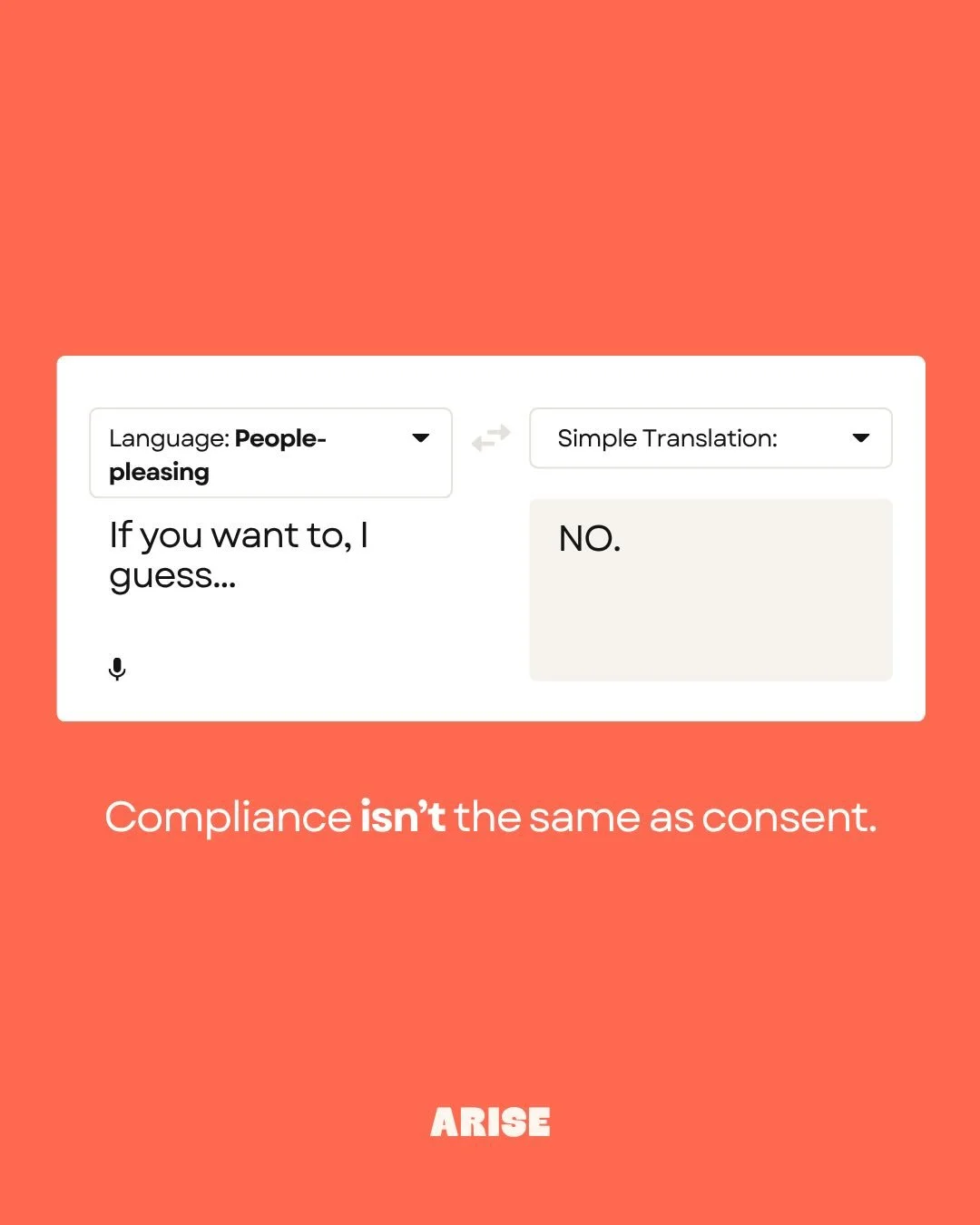
Because a lot of yeses aren't actually yes. They're fine, okay, whatever you want, I guess so, and I don't want to make this weird. They're the yes that comes from not seeing another option. The yes that's really just the absence of no. That's compliance.
And compliance is not consent. The difference between the two isn't just semantic. It's the difference between a genuine agreement and a survival strategy. And until we start teaching people — especially young people — how to recognize that difference, we'll keep mistaking one for the other.

What Consent Actually Looks Like
Genuine consent isn't just about what someone says. It shows up in the whole person — their body, their energy, their engagement. While there are many frameworks for consent education, here are some of the core things to look for:
Freely given. There's no pressure, no obligation, no power imbalance doing the heavy lifting. The person isn't agreeing because they're afraid of what happens if they don't, or because they feel they owe something, or because saying no feels riskier than saying yes.
Reversible. Consent at 8pm doesn't mean consent at midnight. Consent last week doesn't mean consent today. A genuine yes always includes the unspoken right to change your mind — and that right is respected without guilt or pushback.
Informed. The person knows what they're agreeing to. Not a vague or misleading version of it. Not a version that conveniently leaves out the part they might object to. And not under the influence of alcohol or drugs — consent cannot be given when someone is intoxicated. Impairment removes the capacity to genuinely agree, which means it removes consent entirely.
Enthusiastic. This one gets debated, but it's important. Genuine consent tends to look like actual willingness — engagement, presence, reciprocity. It doesn't look like stillness, silence, or someone waiting for it to be over.
Specific. Saying yes to one thing isn't saying yes to everything. Agreeing to one context doesn't transfer to another.
What Compliance Looks Like
Compliance can look identical to consent on the surface. That's what makes it so easy to miss — and so easy to exploit, whether intentionally or not. Watch for these indicators:
Hesitation before agreeing. A pause that gets filled with a yes. Not thoughtfulness — more like someone running a calculation about what it costs to say no.
Flat or absent affect. The body doesn't match the yes. No eye contact, no engagement, going through the motions. Physically present, emotionally checked out.
Qualifiers and softening. "I guess," "if you want," "it's fine," "I don't mind." These phrases are doing work — they're distancing the person from ownership of the yes, leaving a small exit in case the agreement turns out to be a mistake.
No initiation. The person never initiates, suggests, or expresses preference. They only ever respond. Over time, that pattern is telling.
Relief when it's over. Genuine consent doesn't usually produce relief. Compliance does.
Laughter or lightness that doesn't fit. The nervous laugh. The joke that deflects. Someone making something uncomfortable feel casual because the alternative — naming it directly — feels too risky. This is often the fawn response in real time: the nervous system managing threat through appeasement.
So What's a Yes — For You?
Before you can recognize compliance in someone else, it helps to know what genuine consent feels like in your own body. Most of us were never taught to ask that question.
We were taught to be agreeable. To not make things awkward. To go along. So when something doesn't feel right, we override it — talk ourselves out of the discomfort, tell ourselves we're overreacting, and produce a yes that was never really ours.
Learning to tell the difference starts with slowing down enough to actually check in with yourself. Not just what do I think I should say — but what do I actually want?
That's a skill. And like any skill, it takes practice.
Try this grounding exercise before any situation where you need to know your own yes or no:
Find a comfortable position — seated or standing. Take three slow breaths, in through the nose, out through the mouth. Let your shoulders drop.
Now bring the situation to mind — the invitation, the request, the decision in front of you. Don't think about what you're supposed to want. Don't think about how the other person will react.
Just notice what happens in your body when you imagine saying yes. Does your chest open or tighten? Does your stomach settle or clench? Does your energy rise or flatten?
Now imagine saying no. Same questions.
Your body usually knows before your brain catches up. A genuine yes tends to feel like expansion, even if it comes with some uncertainty. A no tends to feel like bracing, like preparation, or getting through something.
There's no wrong answer here. The point isn't to always say no. It's to make sure your yes actually belongs to you.
The more you practise this, the faster it becomes available to you, in low-stakes moments first, and eventually in the ones that matter most.
Why The Distinction Is Hard to Teach — and Why We Have to Anyway
Part of why consent education gets stuck is that it focuses almost entirely on the verbal yes or no. That framing is clean and easy to teach, but it doesn't reflect how most people actually navigate uncomfortable situations.
Many people — especially young people, and especially those who've been conditioned to prioritize others' comfort over their own — default to compliance without even recognizing it. They've never been given language for the experience of going along with something they didn't actually want. They've never been told that their discomfort counts as data, or that they're allowed to act on it.
That's what consent education has to address. Not just get a yes — but what kind of yes? And what does it look like when someone's body and voice are giving you different answers?
Teaching This in Schools
If you're an educator looking to bring this into your classroom, it starts with the culture you establish. Conversations about choice, pressure, and reading the room can begin early and grow with your students.
For ready-to-use classroom resources, the Arise Safety Education consent bundle on Teachers Pay Teachers has curriculum-aligned materials designed to help students understand the difference between genuine agreement and going along to get along — age-appropriate, trauma-informed, and ready to use.
For a broader look at consent education in schools, Teach Us Consent is doing excellent work. Based in Australia and founded after a landmark grassroots campaign, they offer resources, research, and honest conversation about what it actually takes to build a culture of consent — the kind of thinking that translates across contexts, including here in Canada.
The Bigger Picture
Teaching consent isn't really about teaching people to say no. It's about teaching people to know what they actually want — and to believe that it matters.
It's about building enough self-awareness to recognize compliance in yourself, enough empathy to recognize it in someone else, and enough courage to pause when something feels off.
That starts with language. With being able to name the difference between I want to and I feel like I have to. With understanding that a yes given under pressure isn't a gift — it's a transaction. And transactions aren't intimacy, agreement, or safety. The goal isn't perfect consent conversations every time. It's a world where people feel entitled to have them at all.
Arise Self-Defense offers empowerment self-defense programs for women and teens, kids, schools, and workplaces across Metro Vancouver. Our work begins long before any physical technique — with voice, boundaries, and the knowledge that safety starts with you.