What Are Your Self-Defense Rights in Canada? Exploring what the law says.
“What am I actually allowed to do if someone attacks me?"
It's a question that comes up a lot in my classes — usually right after participants have learned something super badass and the reality hits. Could I actually use this? Will I get in trouble? Will anyone believe me?
Don't get me wrong — I love a good philosophy session. There's something genuinely important about reckoning with our capacity to cause harm, to fight back, to make a split-second decision that could have genuine consequences. That moral weight is real, and I don't think we should brush past it. Wrestling with those questions says something good about you.
But underneath all of it, there's something that needs to be clear before any of that philosophizing can happen: you have the right to defend yourself. You have the right to do what it takes to stay safe. Getting clear on that is foundational, everything else can be figured out after you're safe.
Uncertainty can be the difference between acting and hesitation. Not knowing your rights, about whether you're allowed, about whether you'll be believed, are more things standing between you and decisive action. In that moment, hesitation has consequences.
The good news is that Canadian law is actually very clear on what you can and can't do in self-defense — and you have more rights than most people realize. That is what we are exploring here today.

The Law: Section 34 of the Criminal Code
Self-defense in Canada is governed by Section 34 of the Criminal Code. It was updated in 2013 to update old laws with a single, more flexible framework. The core of it reads like this:
A person is not guilty of an offence if:
They believe on reasonable grounds that force is being used or threatened against them or another person
The act is committed for the purpose of defending or protecting themselves or that other person
The act committed is reasonable in the circumstances
These three conditions all have to be met.
The third one — reasonable in the circumstances — is where most of the complexity lives, and it's what a court would examine if you ever had to defend your actions.
What "Reasonable" Actually Means
Here's where people get tripped up. "Reasonable" isn't a fixed line, but a question a court would work through based on the full picture of what happened.
Imagine two scenarios. In the first, a 5'3" woman is cornered in a parking garage by a man who is 6'2", visibly agitated, and blocking her only exit. In the second, two people of similar size get into a heated argument at a bar and one shoves the other.
The legal analysis of what's "reasonable" looks completely different in each case — and that's intentional. The law doesn't define reasonable as a fixed standard. Instead, it lists factors a court would consider, including:
The nature of the threat and how imminent it was
Whether there were other ways to respond (including leaving)
Your role in the incident
Whether a weapon was involved
The size, age, gender, and physical capabilities of everyone involved
Any history between the parties, including prior violence
Whether your response was proportionate to the threat
That last point is critical. The legal standard isn't what a trained police officer or security professional would do. It's what a reasonable civilian in your exact position — with your history, your physical reality, and your available options — would do.
The old legal shorthand still holds: equal level of force, plus one. You're entitled to respond one step above the level of force being used against you, until the threat stops. At that point, you must disengage.
The Use of Force Continuum
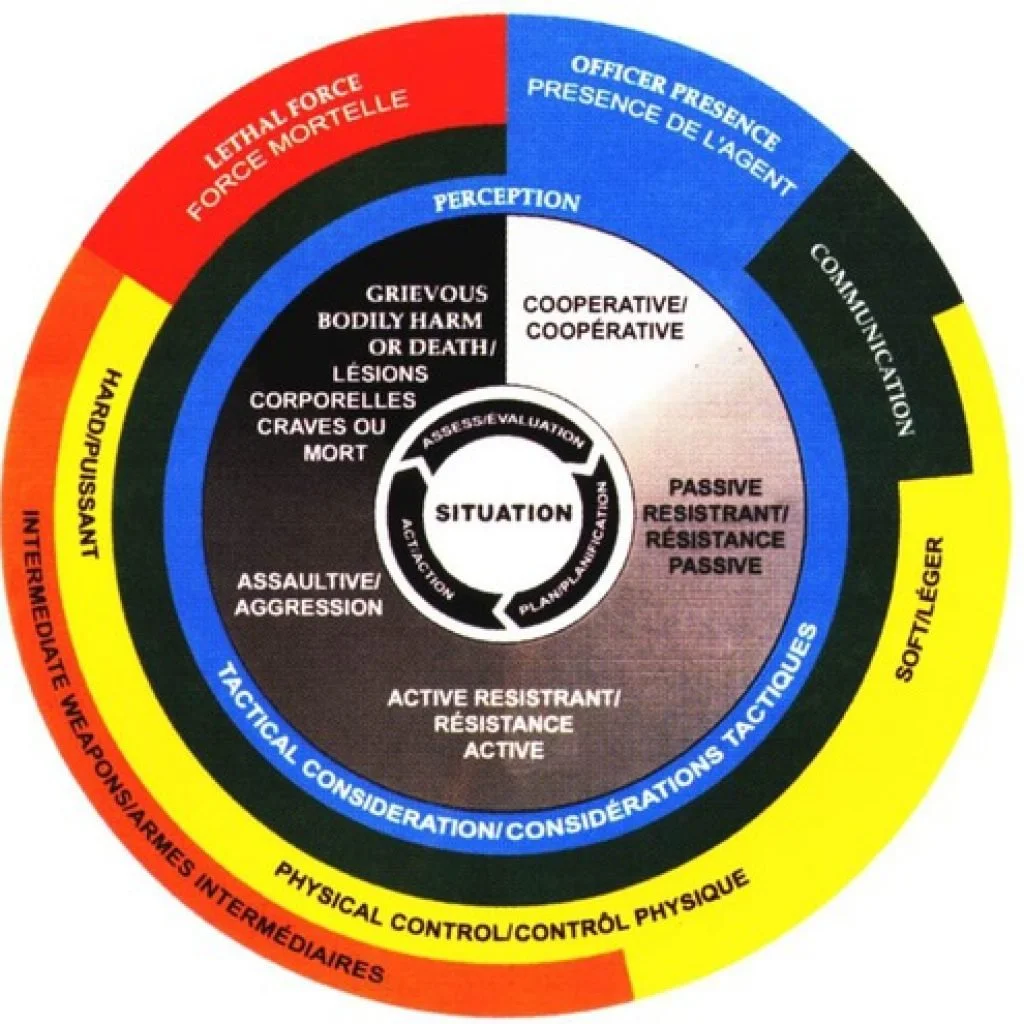
One of the most useful tools for understanding this is the use of force continuum, which is a framework used in law enforcement training that maps the relationship between threat and response.
Think of it as a circle, not a ladder. You don't move through force options in a straight line — you move between them based on what's in front of you at any given second. The options include:
Presence: Simply being there, calm and aware. De-escalation before anything else.
Verbal direction: Using your voice through assertive communication. Commands, redirection, and setting a boundary clearly and loudly.
Empty hand control (soft): Physical redirection, blocking, creating distance without striking.
Empty hand control (hard): Strikes, takedowns, and holds intended to stop an active threat.
Intermediate weapons: Tools like pepper spray that create distance or incapacitate without lethal force.
Lethal force: Reserved for situations where death or grievous bodily harm is imminent and unavoidable.
For civilians, the circle model is especially useful because it reinforces that force is not a one-way escalation. You can — and should — de-escalate at any point. Your goal is always to get safe, not to win a fight.
The continuum is useful beyond physical altercations, too. Sexual and gender-based violence follows a similar spectrum, from conduct deficiencies that often get dismissed as minor, all the way to criminal acts. Understanding where behaviour falls on that spectrum is what makes early intervention possible. This post breaks it down in full.
Which brings us to what is arguably the most important principle in Canadian self-defense law.
You Win Every Fight You Don't Have
My co-facilitator Janna says this all the time and it’s great advice. Everyone thinks it’s fun to learn how to fight, and it is in safe and respectful conditions (ie. in a gym with mats and rules), unfortunately the realty of violence is less forgiving.
So, if you can safely leave, the law expects you to.
This doesn't mean you have to flee at all costs or that running is always possible. But if escape is a genuine option, the legal expectation is that you take it. Choosing to stay and fight when you could have left changes how your actions are assessed by a court.
There are exceptions. You don't have to escape if:
You can articulate that the person would continue to be a threat to others who can't escape
You can articulate that the person could overtake you — they're faster, blocking your exit, or between you and the door
A weapon is being used to keep you there
If any of those are true, your right to defend yourself remains intact even if escape technically existed.
You Don't Have to Wait to Be Hit First
This is one of the most important — and most misunderstood — points in Canadian self-defense law.
You are not legally required to absorb the first blow before responding. If the threat is clear and imminent, you can act before physical contact is made. This is where pre-assaultive cues become not just a safety skill but a legally relevant one.
Pre-assaultive cues are the behavioural and physical signals that appear when someone has decided to be violent. They often show up 10–60 seconds before an assault. Recognizing them is what gives you time to respond and the ability to articulate what you observed is what supports a legal defense.
Physical cues driven by the body's adrenaline response:
Sudden change in skin colour — flushing or going pale very quickly
Muscle clenching — jaw, fists, trapezius muscles, lips drawing back
Limbering up — bouncing on the balls of the feet, rubbing hands together, small punching motions
Changes in eye blink rate — either rapid blinking or a fixed, unblinking stare
Going suddenly quiet
Behavioural cues:
Target selection — sustained attention on you that feels different from a passing glance
Checking for witnesses — looking around before focusing back on you
Flanking — moving to cut off your exit
Boundary testing — closing distance when there's plenty of open space
Targeting glance — repeatedly looking at where they intend to strike
Handling a potential weapon — testing weight and grip of an object
Hands kept out of sight
Understanding what a threat looks like from the outside is one skill. Understanding what's happening on the inside — why we freeze, fawn, or go along with something that doesn't feel right — is another. If you want to go deeper on that, this post on consent vs. compliance breaks down exactly why compliance isn't the same as agreement, and what your body is actually telling you when something feels off.
The Bottom Line
Canadian self-defense law gives you your rights — more than most people realize. You don't have to wait to be struck. You can defend someone else. You can respond to a credible threat before it fully materializes.
But those rights come with a standard. They need to be reasonable, proportionate, and explainable.
The best position to be in legally is the same as the best position to be in physically: you did what any reasonable person in your situation would have done, you stopped when the threat stopped, and you got yourself to safety. If you can articulate that, you’re good.
And if you do have to use your rights — if something happens and you find yourself having to decide whether to report it — that's a whole other conversation. One that deserves its own space. This post on why women don't report breaks down some of the barriers, because knowing your legal rights and feeling safe enough to use them are also two very different things.
This post is for educational purposes only and does not constitute legal advice. If you have specific questions about a situation, consult a lawyer.
I also credit Janna Pansegrau for much of this knowledge 🙏🏻
Arise Self-Defense offers empowerment self-defense programs for women and teens, kids, schools, and workplaces across Metro Vancouver. Our work begins long before any physical technique — with voice, boundaries, and the knowledge that safety starts with you.